If you live in Australia, you know summer. The heat. The humidity. The electricity bill after running the air con non‑stop. I’ve been fitting ceiling fans in homes for years, and I still reckon they’re one of the smartest things you can put in a house.
A good ceiling fan won’t just cool you down it’ll save you money, make your home more comfortable, and last for decades if you look after it. But there’s a lot more to it than just picking one off the shelf. Size matters. Placement matters. And sometimes they need a bit of TLC to keep running smoothly.
This guide covers everything I’ve learned about ceiling fans and cooling. Whether you’re building new, renovating, or just sick of sweating through another summer, I’ll help you get it right.
Key Takeaways
- Ceiling fans are cheaper to run than air conditioners. They use a fraction of the power and can cut your cooling costs by a lot.
- Bigger isn’t always overkill. In the right space, large fans move more air with less noise and lower energy use.
- Placement matters. A fan in the wrong spot won’t cool you properly. Getting it right makes all the difference.
- Fans need maintenance. If yours wobbles or clicks, it’s telling you something. A quick fix can make it good as new.
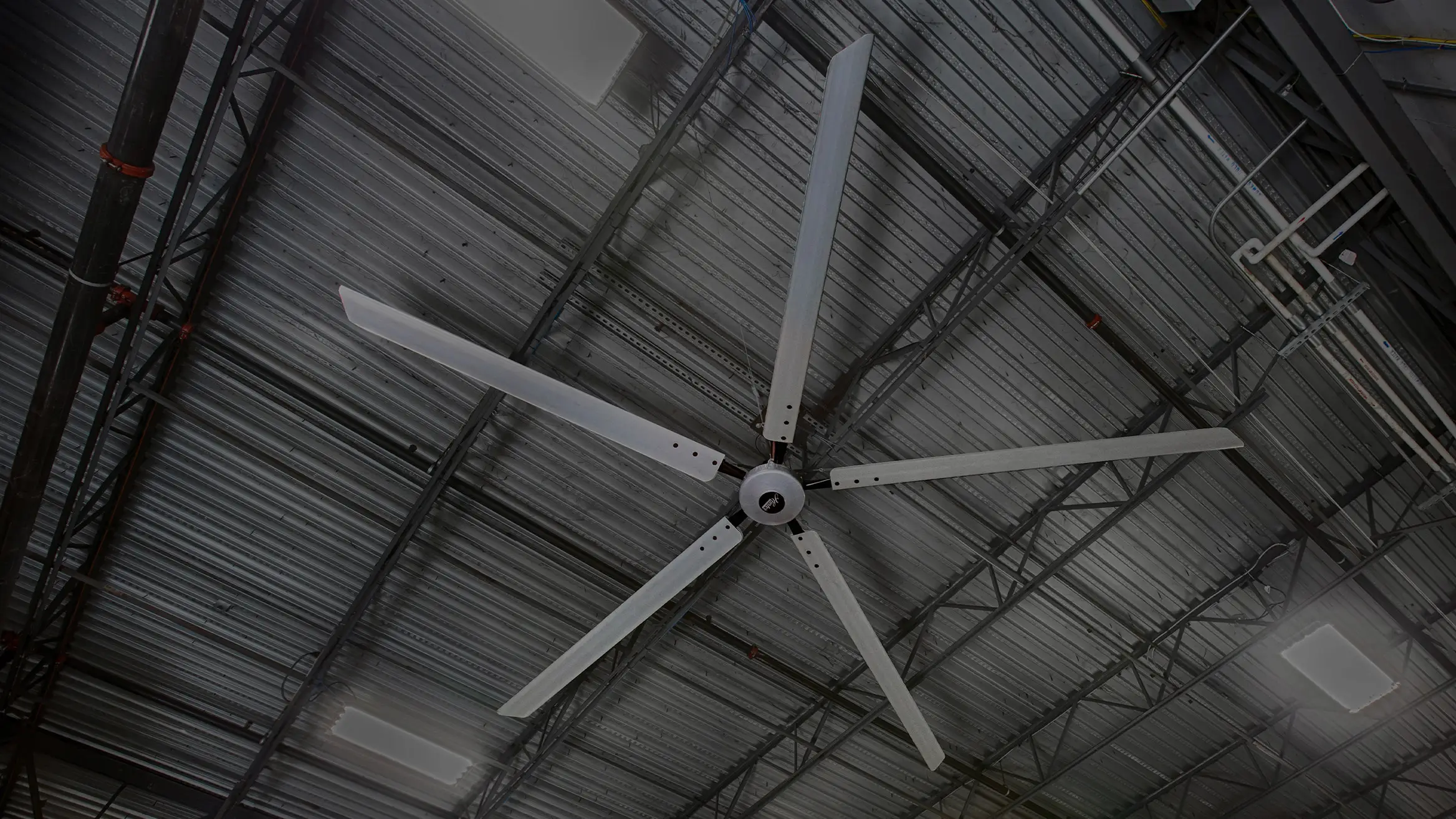
- Industrial fans aren’t just for factories. Big spaces like warehouses and workshops need proper airflow too, for safety and comfort.
Why Ceiling Fans Still Make Sense
I get asked all the time: “Why would I put in a ceiling fan when I’ve got air con?” And I get it. Air con is great. But it’s expensive to run, it breaks down, and it doesn’t always reach every corner of a room.
A ceiling fan does something air con can’t. It moves air. That breeze across your skin cools you down by pulling heat away. It’s the same reason you feel cooler at the beach on a windy day. A good fan can make a room feel several degrees cooler without actually changing the temperature.
And the running cost? A modern ceiling fan uses about the same power as a light bulb. Run it all day, and it’ll cost you cents. Run an air con all day, and you’ll notice it on your bill.
Picking the Right Fan for Your Space
Not all fans are the same, that’s for sure. Walk into any hardware store and your head will spin. Dozens of them, all different sizes, styles, prices. So how do you pick the right one?
Blade Size Matters
The biggest stuff‑up I see is people buying a fan that’s too small for the room. They get this little fan for a big living area and wonder why they’re still sweating. A tiny fan in a big space just stirs the air. It doesn’t cool you down. You need enough blade to actually move a decent amount of air.
Here’s a rough idea:
- Small room, like a bedroom up to 3 metres by 3 metres: go 90 to 100cm blades.
- Medium room, around 4x4: 100 to 120cm.
- Large room, up to 5x5: 120 to 140cm.
- Open plan or big spaces: 140cm or bigger. Sometimes you’re better off with two fans instead of one massive one.
Indoor vs Outdoor
If you’re putting a fan on the patio or alfresco area, don’t just grab any old one. You need one rated for outdoor use. Damp‑rated or wet‑rated fans are made to handle humidity, moisture, and the odd splash. Stick an indoor fan out there and it’ll rust up and die in no time. Seen it plenty of times.
Style and Look
Let’s be honest, you want something that looks good too. I get it. Modern fans come in all sorts sleek and minimal, timber blades, ones with lights built in. Pick something that suits your room, but don’t fall in love with a fan that doesn’t actually work. I’ve seen people buy fancy‑looking fans that barely move any air. Looks great on the ceiling, does nothing for your sweat.
Energy-Efficient Cooling
You know that feeling when you open your summer power bill and your stomach drops? Yeah, me too. Air conditioners are greedy little things. They can use 10 to 20 times more power than a ceiling fan.
So here’s how these large ceiling fans cut your power bills in real life.
The large fan has the ability to cool a room by 4 degrees. Not really cool down the temperature, just feel colder. That is, you can crank your air con on higher 24 or 25 rather than 21 and you are still comfortable. With each step you increase the air con, you cut down on the cooling expenses by approximately 10%. You do not turn on the air con full blast during the day but rather the fan. Or you run both, but with the air con set higher. The fan does the hard work of making you feel cool, and the air con just takes the edge off.
And if you’ve got a decent‑sized living area, a big fan running slow moves more air than a small fan screaming its head off. Less noise, less energy, better cooling.
Do Large Ceiling Fans Work Better Than Air Conditioning?
Brisbane summers are their own beast. Hot, humid, and they go for months. I’ve worked all over Queensland, and if there’s one place where ceiling fans really earn their keep, it’s Brisbane.
Here are the 5 reasons large fans beat air con up here.
1. They handle the humidity better.
Air con pulls moisture out of the air, which is good, but it also makes the air feel dead. A fan keeps things moving. That breeze helps sweat evaporate off your skin. In humidity, that moving air is gold.
2. They cost bugger all to run.
A big fan uses about 50 to 80 watts. A medium air conditioner? Upwards of 2,000 watts. Do the maths. In Brisbane where you might need cooling eight months of the year, that adds up quick.
3. You can leave the windows open
Brisbane nights often cool down. With a fan, you can throw the windows open, let the breeze in, and still have the fan moving air. You can’t do that with air con. You’re sealed up like a tin can.
4. They work with the natural airflow.
A large fan can pull air through the house if you’ve got windows and doors positioned right. It works with your home, not against it.
5. They don’t break down as often.
Air cons have compressors, gas, filters, all that. Fans are simple. A good one will run for 20 years with basic maintenance. Try that with a split system.
Why Large Ceiling Fans Are Brisbane’s Smart Cooling Solution for Modern Homes
Modern homes in Brisbane are designed differently than the old Queenslanders. Big open‑plan living, high ceilings, lots of glass. They look great, but they can turn into ovens in summer.
That’s why for modern homes large ceiling fans are the smart cooling solution. A single large fan can cool a whole open‑plan area without needing multiple smaller fans cluttering the ceiling. They’re quiet, they’re efficient, and they fit the aesthetic.
Builders and architects are putting them in more and more. You see them in new builds with high ceilings big timber blades, sometimes no light, just a statement piece that actually does the job. And because they use so little power, they’re perfect for homes with solar panels. You can run them all day off what the sun makes.
How Large Ceiling Fans Improve Warehouse Ventilation
It’s not just homes. I do a fair bit of work in warehouses and workshops, and the same principles apply. Big spaces need big airflow.
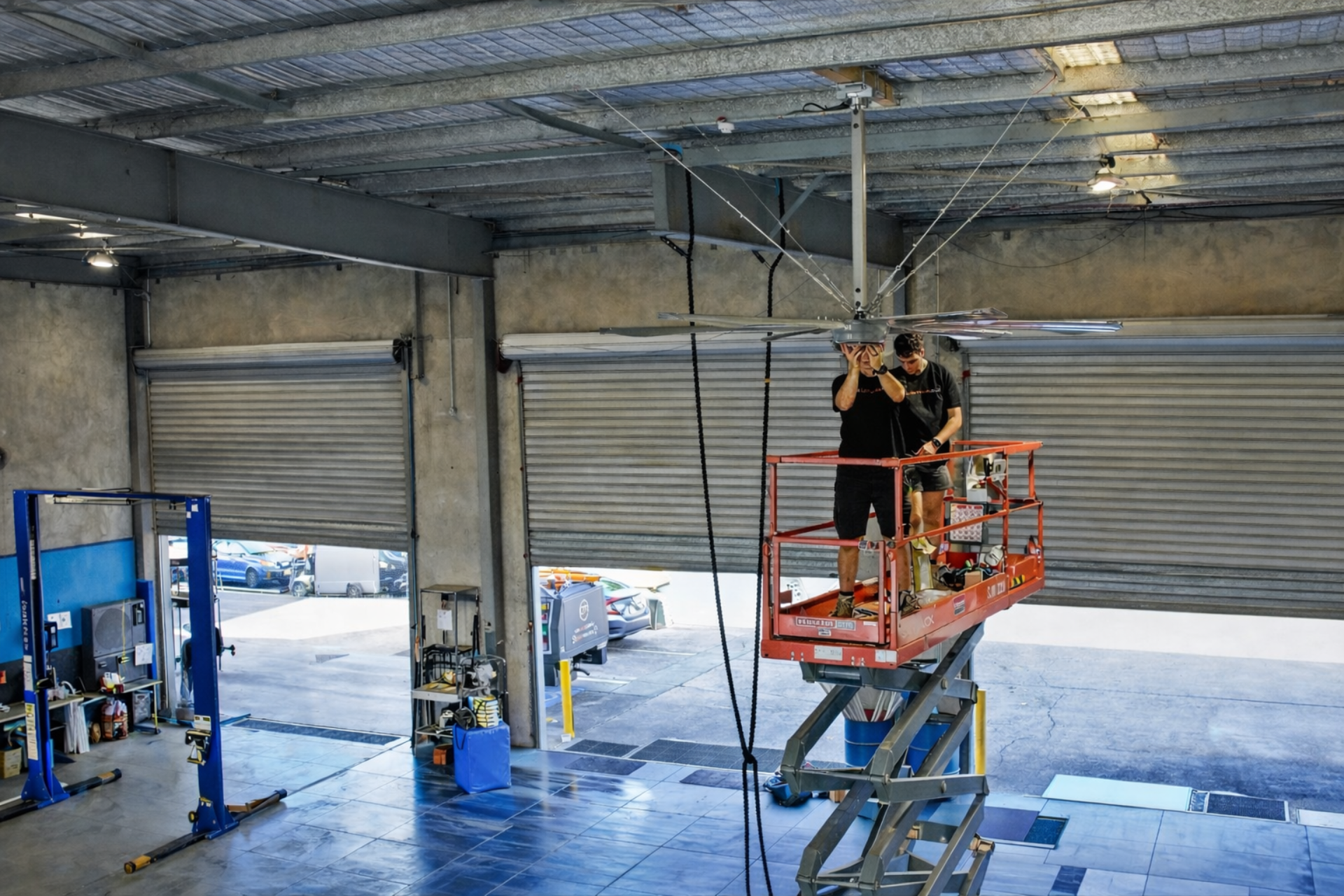
How large ceiling fans improve warehouse ventilation is something I’ve seen firsthand. A couple of well‑placed industrial fans can keep a whole warehouse comfortable. They push hot air down in winter and create a breeze in summer. They stop the air from getting stagnant, which is important when you’ve got people working in there all day.
Warehouses also have issues with moisture, fumes, and dust. Moving the air around helps all that. It keeps things drier, which stops rust and mould. It dilutes fumes from forklifts or equipment. And it makes the place feel less stuffy, which means workers are happier and safer.
Why Is My Ceiling Fan Wobbling? Tips to Fix It Safely
I get calls about wobbly fans all the time. Someone rings up and says, “Mate, my fan’s shaking like crazy. Reckon it’s gonna fall on my head?” And honestly, that’s a fair worry. A fan that wobbles too much can work itself loose over time.
So why is my ceiling fan wobbling? Let’s start with what causes it.
Most wobble comes from one of three things:
- Blades out of balance. Even a tiny difference in weight from one blade to the next can make the whole thing shake.
- Screws have come loose. . Over time, vibration can loosen the screws holding the blades, the bracket, or even the fan to the ceiling.
- Bent blade brackets. .If the metal arm that holds the blade is bent, that blade sits at a funny angle and throws everything off.
How to Fix It
The first one is to switch off the fan and wait till it comes to a stop. Do not attempt to fiddle with it whilst in revolution. That is asking to be in trouble.
Take a screwdriver and verify all screws that can be found. Blade screws. The screws of the fan that are attached to the ceiling bracket. The screws on the bracket itself. Just tighten them up. Do not use a drill, use a screwdriver, otherwise you will strip the threads.
You may have to balance the blades, in case it is still wobbly after that. A majority of fans come with some balancing equipment which is small weights that you attach to the blade to even it out. Or you may see whether it would help to change blades about.
If you’re not confident, just call an electrician. A wobbly fan can get dangerous if it’s left too long. Better to have someone look at it than have it come down one day.
Enhancing Workplace Safety and Air Quality
I do a bit of work in factories, big sheds, and commercial kitchens. In places like that, airflow isn’t just about being comfortable. It’s about safety.
The role of these large ceiling fans in enhancing workplace safety and air quality is massive. Go into a workshop on a hot day with no fans on and you will feel it immediately. The air is thick. The atmosphere is filled with dust, or fumes, perhaps, of welding, and machine heat. All that will just sit there when nothing is moving.
Everything is different with a large industrial fan. It blows that stuffy air away and the fresh air in. It purifies the air, keeps people cool, and prevents the space being like an oven. It prevents grease and steam to accumulate on everything in a kitchen.
And it’s not just big factories. Any workplace where people are on their feet all day needs good airflow. I’ve seen what a couple of well‑placed fans can do. People work better when they’re not sweating buckets. They’re less tired. And when people aren’t exhausted from heat, there are fewer accidents. Simple as that.
Fixing the Clicking Sound: Make Your Ceiling Fan Happy Again
Clicking. Tick. Tick. Tick. It drives people crazy. A ceiling fan that clicks every rotation is annoying, but it’s usually an easy fix.
Common Clicking Causes
- Loose blade screws. The blade moves slightly with each rotation, clicking against the bracket.
- Blade touching something.Sometimes a blade is just close enough to the ceiling or light fitting that it taps with every pass.
- Loose light kit. If the fan has a light, the glass or fitting can rattle.
- Dry bearings. Older fans can develop a click from bearings that need lubrication.
How to Fix It
- Turn the fan off and wait for it to stop.
- Check every blade screw. Tighten them if they’re loose.
- Spin the fan by hand slowly and watch for any blade that touches something.
- If you have a light kit, check that the glass is seated properly and the screws are tight.
Try these fixes and make your ceiling fan happy again. And if it’s still clicking than it might be the motor bearings. That’s a job for an electrician or sometimes it’s easier to replace the fan if it’s old.
A quiet, smooth‑running fan is a happy fan. A little maintenance keeps it that way.
Ceiling Fan vs Air Con: Which One Should You Use?
This is the question I get most. Here’s how I answer it.
Use a ceiling fan when:
- You’re in the room and you just need to feel cooler.
- You want to save power.
- You have the windows open.
- You’re sleeping fans are quiet and create a gentle breeze.
Use air conditioning when:
- The outside air is too hot or humid to help.
- You need to cool the room down before you get in.
- You have guests and need consistent temperature.
- The fan just isn’t enough on those 40 degree days.
Best of all? Use both. Run the fan with the air con set a few degrees higher. You’ll stay just as cool and save money.
FAQs
Check blade screws, make sure nothing is touching the blades, and check the light kit if it has one. If the motor is clicking, get a pro to look at it.
Absolutely. They move huge amounts of air, improve safety, and make working in the space much more comfortable.
Up to you. Light kits are handy, but they add weight and can be a source of noise if not fitted right. If you need light, get one where the light is integrated well.
Yes. Most fans have a reverse switch. In winter, run it clockwise on low speed. It pushes warm air down from the ceiling without creating a draft. Keeps the room warmer without running the heater as hard.
Message by CM Electrical
Ceiling fans are one of the simplest, smartest things you can put in your home. They cost little to run, they last for years, and they make your place so much more comfortable.
If you’re building or renovating, think about putting in larger fans especially in open‑plan spaces. If you’ve got an old fan that wobbles or clicks, spend an hour fixing it. And if you run air con, use the fan with it. Your power bill will thank you.
Take a look around your place. Could a fan make a difference? In most Aussie homes, the answer is yes.